
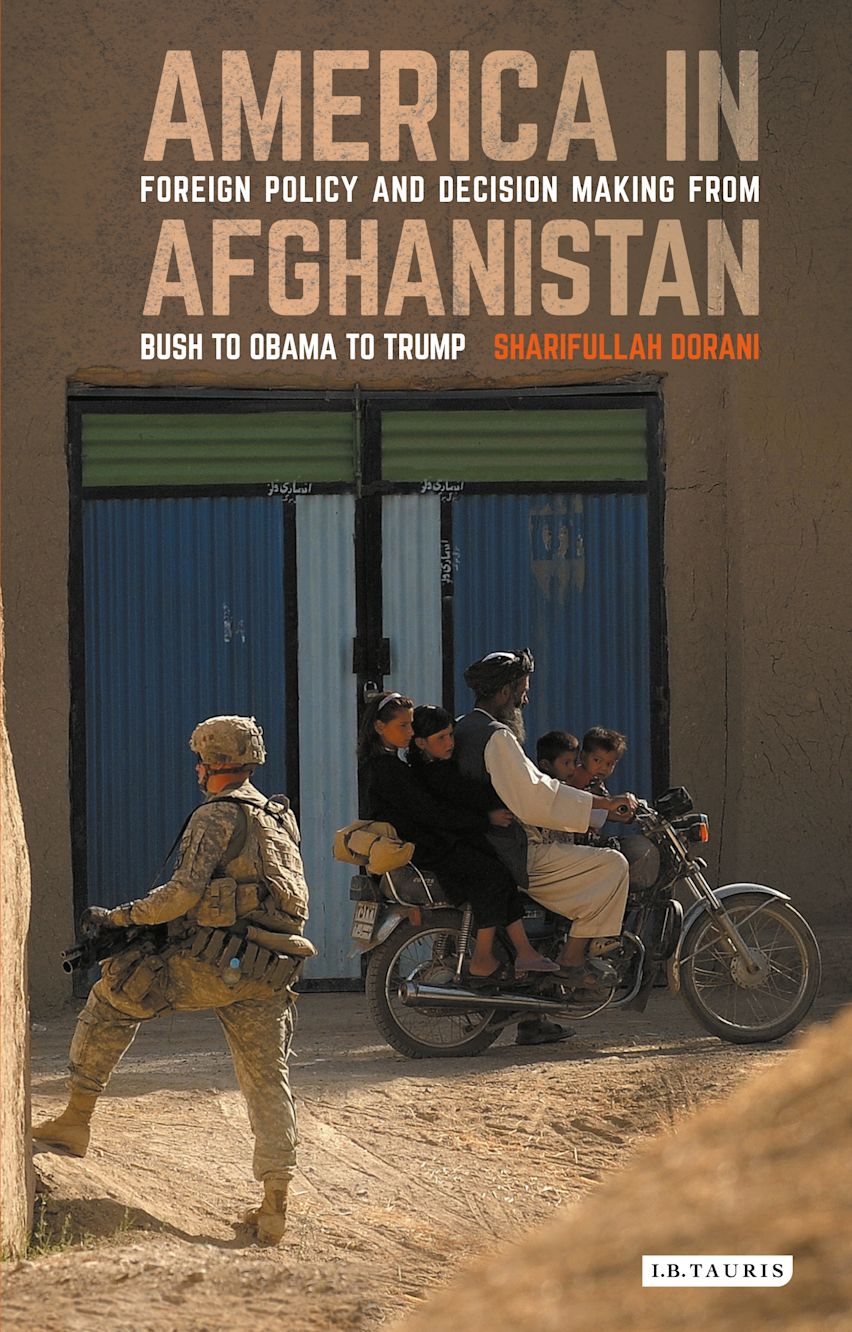
Author: *Sharifullah Dorani
Original Publication: Political Reflections
Date of Publication: January/February 2019
Photo credit: Original book cover
Overview
In this article, Sharifullah Dorani offers a concise and authoritative summary of his book America in Afghanistan: Foreign Policy and Decision Making from Bush to Obama to Trump, originally published by I.B. Tauris (and later by Bloomsbury). Drawing on extensive research and an Afghan perspective, Dorani examines why American strategy faltered across the administrations of George W Bush, Barack Obama, and Donald Trump.
Author’s Main Argument
Afghans initially placed great hope in the 2001 international intervention, reassured by Western leaders that Afghanistan would not be abandoned again. Yet, nearly two decades later, the country appeared more fragile than before. Dorani structures his analysis around six major Afghan questions concerning US motives, failures, governance, the strength and persistence of the insurgents and their regional supporters, misconceptions about Afghan history, and abrupt shifts in American policy.
An Afghan Perspective — and a Critical Clarification
A central contribution of Dorani’s work is its insistence on interpreting US actions from within Afghan political and social realities. He emphasises that:
He did not support the initial US intervention in Afghanistan, nor did he support a prolonged US military presence. But given the reality created by both decisions—and the deep vulnerabilities the Afghan state faced—he argued that the only ethical and strategically sound course was a responsible, safeguarded, and orderly withdrawal, not a disorderly exit that would expose Afghans to collapse, reprisals, or domination by insurgent networks.
This distinction sets his position apart from both pro-intervention narratives and calls for an abrupt US departure.
Key Strategic Missteps Identified
Dorani outlines several policy decisions that weakened Afghanistan’s transition:
• The early diversion of US attention and resources to the Iraq War.
• Delegating core responsibilities to NATO, which led to uneven security provision and slow institutional development.
• Reliance on warlords and the wider “powerful syndicate,” undermining central governance.
• Rejecting early opportunities to negotiate with the Taliban.
• Disjointed development spending that fuelled corruption.
• Empowering private security firms as parallel and unaccountable forces.
• Obama-era decentralisation and accelerated drawdown reducing US influence and credibility.
• Continued failure to develop strategies capable of confronting the insurgency and the regional networks that supported it.
Dorani argues these failures stemmed not from malice but from misinformed assumptions and the belief that these policies were strategically economical.
“Selling Afghanistan” — A Warning That Became Reality
Dorani warned that the United States might eventually “sell” Afghanistan to the insurgents and their regional backers—meaning:
• prioritising American security assurances over Afghan political stability;
• accepting arrangements favourable to insurgent forces if such arrangements guaranteed that Afghan soil would not again threaten the United States.
After the Doha process and the collapse of the Afghan Republic in 2021, this warning—once hypothetical—has become a historical reality.
Afghans’ long-standing fear materialised: external actors negotiated Afghanistan’s future without Afghan safeguards or representation.
Purpose of the Book
The article makes clear that the book’s purpose is to reinterpret U.S. decision-making through Afghan lenses. By analysing six pivotal decisions across three presidencies, Dorani shows why American intentions repeatedly failed when confronted by Afghan political, cultural, and regional complexities—and how Afghans themselves interpreted these shifts.
➡Link to the article: America in Afghanistan: Foreign Policy and Decision Making from Bush to Obama to Trump
*Dr Sharifullah Dorani holds a PhD from Durham University on America’s Afghanistan War, a Master of Laws from University College London, and a degree in law from the University of Northampton, all in the UK. He is the author of numerous scholarly articles and two acclaimed books: The Lone Leopard, a novel set in Afghanistan, and America in Afghanistan, published by Bloomsbury Publishing. He is the founder of CEPSAF and serves as the South Asia and Middle Eastern Editor at CESRAN International. All of Dr Dorani’s work is written to the highest academic standards, is widely indexed through Google Scholar, and is available in the libraries of hundreds of institutions worldwide, including Oxford and Harvard.