
External Reviewer: *Dr Sharifullah Dorani
Original Publication: Journal of Global Analysis
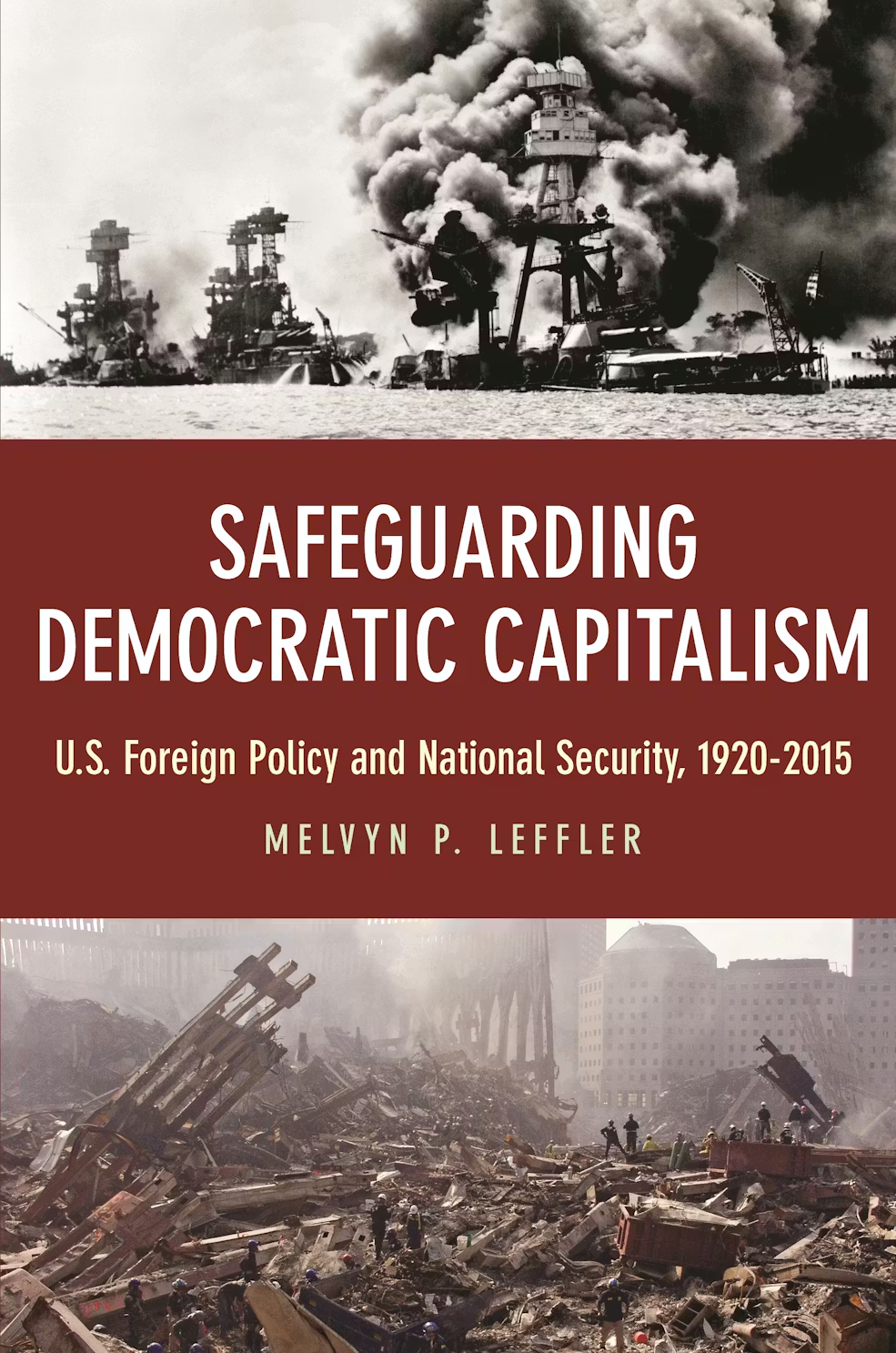
Book: Safeguarding Democratic Capitalism by Melvyn P. Leffler
Author: Melvyn P. Leffler
Photo credit: Original book cover
Key Comment
Dr Sharifullah Dorani highlights the exceptional breadth of Leffler’s five decades of scholarship and argues that the book stands out as one of the most nuanced attempts to explain the drivers of United States foreign policy. His central assessment is clear: Leffler offers a sophisticated, empirically grounded account of how leaders sought consistently—though imperfectly—to protect what he terms “democratic capitalism”.
Summary of the Review
Dr Sharifullah Dorani provides a detailed and rigorous evaluation of Safeguarding Democratic Capitalism, presenting the book as a culmination of Melvyn P. Leffler’s nearly fifty years of scholarship. The volume, a collection of eleven essays supported by a substantial introduction, investigates the independent variables that shaped United States foreign and national security policy from the aftermath of the First World War to the Global War on Terror.
Dorani stresses that Leffler’s central conclusion is consistent across periods: regardless of which causal factors—domestic politics, economic pressures, systemic constraints or human agency—were at play, US policymakers were ultimately motivated by a determination to protect “democratic capitalism”, defined as the union of America’s political liberties and its economic principles of free enterprise and open markets. He notes that while economic considerations mattered, Leffler demonstrates that they were never sufficient on their own to explain policy choices.
Each chapter is summarised with careful attention. Early essays show that the 1920s Republican administrations were neither isolationist nor expansionist, but pragmatic actors navigating domestic opposition, limited resources and complex external conditions. Later chapters demonstrate how threat perceptions—particularly after the Second World War—led to an expansive conception of national security that helped drive the onset and persistence of the Cold War.
Dorani emphasises Leffler’s argument that both US and Soviet leaders misinterpreted one another’s intentions, setting in motion a cycle of “actions and reactions” that hardened ideological divisions. Other essays highlight the decisive role of individual leaders—such as Mikhail Gorbachev, Ronald Reagan and George W. Bush—in shaping the end of the Cold War and the conduct of the Global War on Terror. Dorani notes that Leffler challenges triumphalist explanations, instead showing that the West “won” the Cold War because democratic capitalism proved more effective in meeting the needs of its people.
The review also engages critically with Leffler’s method and conclusions. Dorani questions how realism and revisionism can meaningfully be combined; whether Gorbachev is overcredited; whether reliance on military archives risks neglecting civilian decision-making; and whether the post-9/11 period does, in fact, represent continuity rather than a substantive shift in U.S. policy. He argues that many analysts would dispute Leffler’s claim that the Global War on Terror reflected only tactical rather than policy change.
Nonetheless, Dorani concludes that Leffler’s work is “well-researched and brilliantly written”, offering both scholars and policymakers valuable insights. It is, he argues, essential reading for students of Foreign Policy Analysis and International Relations, and a reminder that historical interpretation—done poorly—can have dangerous consequences for future policy.
➡Link to the Review: Safeguarding Democratic Capitalism: U.S. Foreign Policy and National
Security, 1920–2015
*Dr Sharifullah Dorani holds a PhD from Durham University on America’s Afghanistan War, a Master of Laws from University College London, and a degree in law from the University of Northampton, all in the UK. He is the author of numerous scholarly articles and two acclaimed books: The Lone Leopard, a novel set in Afghanistan, and America in Afghanistan, published by Bloomsbury Publishing. He is the founder of CEPSAF and serves as the South Asia and Middle Eastern Editor at CESRAN International. All of Dr Dorani’s work is written to the highest academic standards, is widely indexed through Google Scholar, and is available in the libraries of hundreds of institutions worldwide, including Oxford and Harvard.