
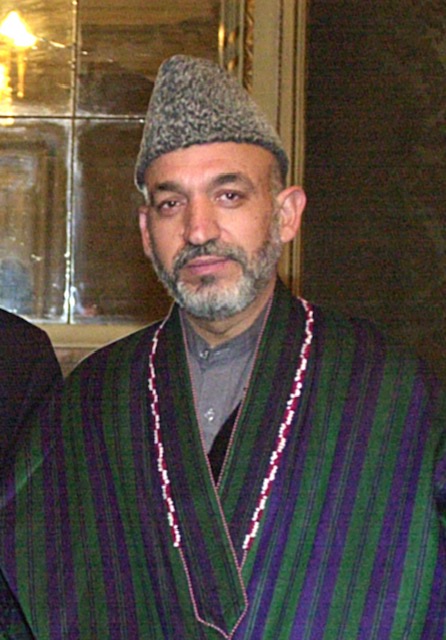
Photo Credit: Hamid Karzai portrait (2002) – Public domain (USAID/US federal government)
By Dr Sharifullah Dorani*
‘After our assault on Kabul, the United States had brought Karzai and his advisors back and installed them in power―functional expatriates we hoped would serve as the Afghan face of a new, nonmilitant order…[T]hey did their best to persuade us that a modern, tolerant, and self-sufficient Afghanistan was within reach so long as American troops and cash continued to flow.’[1] President Obama on President Karzai and his advisors
Introduction
The poor relationship between the US and the most ‘troublesome’ ally the US had since WWII,[2] Afghan President Hamid Karzai, is said to be one of the most crucial reasons that little progress was made on US strategy in Afghanistan, particularly the political side of the strategy, markedly on Karzai’s promises to curb corruption.[3] This article examines the main factors that led to disagreements between President Hamid Karzai and the US (and, to some extent, NATO allies) and their implications for US-Afghan relations.
Karzai, once hailed as the ‘West’s man in Kabul’, became arguably the most ‘troublesome’ ally the United States had seen since World War II. Over the course of his presidency, from the 2001 intervention to his departure in late 2014, Karzai’s relationship with Washington deteriorated from a cooperative alliance to one marked by public animosity and deep mistrust, which proved a major obstacle to the success of the US/NATO strategy in Afghanistan. This article will demonstrate that the deterioration of this relationship was a result of several key factors: Karzai’s belief that the true source of instability lay in Pakistan; his confusion over the US’s shifting goals and priorities; his vocal condemnation of collateral damage (civilian casualties) and ‘human rights violations’; his opposition to US policies on decentralisation, warlordism, and corruption; and his perception of betrayal. By exploring these points of contention, we can see how a failure to align on strategic issues led to a fundamental breakdown in trust, ultimately proving a major obstacle to the success of the entire military, civilian and political components of the US (and NATO) strategy in Afghanistan, especially President Barack Obama’s surge in 2009.[4]
Incidentally, the disagreements began in 2005, in the first years of the Bush Administration, but became more public during the Obama Administration (and during the terms of Presidents Donald Trump and Joe Biden, even though Karzai was no longer the president).[5] The analysis below is therefore relevant to all four US presidents in office during the Afghanistan War.
Early cooperation between the US/NATO and Karzai
As Obama writes above, Karzai rose to prominence as a US-supported leader in late 2001 after the fall of the Taliban. Reportedly, the Bush Administration saw him as a moderate, reliable partner who could help stabilise Afghanistan and build a new government. In the beginning, the US (and NATO allies) provided substantial financial aid, military backing, and diplomatic support. However, as the insurgency persisted and governance problems mounted, tensions began to surface.
The problems originated from Pakistan, not Afghanistan
For the ‘pacifist’ Karzai, the roots of the problems did not lie in the Afghan villages and provinces, but over the borders in Pakistan which had the ideological, financial, motivational, political and military centres of terrorism that enabled the infiltration of insurgents into Afghanistan. The US should stop killing innocent Afghans, argued Karzai in an interview with Time Magazine, and instead find a strategy to deal with Pakistan’s double game and the sanctuaries.[6] Since the sanctuaries were not addressed, Karzai was ‘outright convinced’ that the US (and NATO) strategy would fail.[7]
The unclarity of US goals in Afghanistan
Karzai clearly seemed to be at a loss to ascertain what really the US goal in Afghanistan was! Karzai was told by the Americans that the Taliban was not their enemy anymore and that Al-Qaeda was not present in Afghanistan. If the Taliban were not an enemy, and if there was no Al-Qaeda present in Afghanistan, why were American forces in Afghanistan, and who were they fighting?
For Karzai, especially National Security Advisor Rangin Spanta (as well as most members of the Northern Alliance), those Taliban who were killing innocent Afghans, burning schools, and destroying crops on a daily basis were terrorists. For the Afghan Government, defeating the Taliban was more important than defeating Al-Qaeda, whose very existence Karzai doubted. For Karzai, the Afghanistan War was not an insurgency but a war on terrorism. If the former, then it was an Afghan issue and the US should not be in the country to support one brother against another.[8]
Towards the end of his presidency, Karzai did not believe that the US/NATO war in Afghanistan was in Afghanistan’s interests; for him, the war overwhelmingly served Western security goals. According to Karzai’s interview with The Washington Post, his countrymen and women died in a war that was not theirs.[9]
Alleged human rights violations by the US and NATO forces in Afghanistan
‘Afghans increasingly complained about certain U. S. tactics―nighttime raids on homes suspected of harboring Taliban fighters, for example―that they viewed as dangerous and disruptive but that our commanders deemed necessary to carry out their missions.’[10] President Obama on US tactics that Karzai and Afghans viewed as human rights violations
Karzai continuously pleaded with the US (and the NATO allies) to put a stop to their collateral damage, night raids, house searches, American prisons, the use of dogs on patrols, body searches of Afghan women, and other ‘human rights abuses’ (all took place without meaningful consultation with Afghan authorities). These highly sensitive issues to Karzai, most importantly, collateral damage, became a major source of friction between the Afghan President and the Obama Administration. For Karzai, civilian casualties detracted from the stated US mission of promoting security and rebuilding Afghanistan, and instead made ordinary Afghans resent foreign troops, adding that these grievances would become rallying points for Afghan nationalism and opposition to foreign military presence as they violated Afghan sovereignty and fueled resentment among the population.
At a loya jirga (traditional Afghan assembly), he stressed that Afghanistan sought a ‘strong partnership’ with the US and NATO, but only on conditions that respected Afghan control over security operations, particularly ending night raids and detentions conducted without Afghan oversight.
The Americans consistently told Karzai and the media how sorry they were, that wars had collateral damage, and that they worked hard to minimise it. But ‘sorry’ was hardly good enough for the Afghans. Karzai felt that the Afghans wanted answers from him as an elected leader. But the Americans seemed not to be doing enough, or even not listening to Karzai. Karzai had raised the issue of collateral damage as far back as 2006, but in the view of Karzai, nothing effective had been done yet. Karzai had raised the issue of security companies in 2006, but it was only in 2010 that the US offered a plan to address them, when the presence of those companies had become a crisis.
Security firms with 40,000 personnel had created a parallel structure to the police, yet they were hardly accountable to the Afghan Government. Stanley McChrystal, who was US Commander in Afghanistan from June 2009 to June 2010, said in 2013 that US and coalition forces fought a war almost by themselves, hardly involving the Afghan Government in making (not just in Afghanistan but also in Washington) and implementing the strategy. As a result, the Afghan President was sidelined and had no meaningful role.
Karzai wanted to be a partner not a ‘stooge’, who would keep quiet if a wrong was committed by the US (and the NATO allies). Since he felt he was not treated like a partner, Karzai had no choice but to turn to the media and publicly criticise America.
The ‘nationalist’ Karzai, who, according to Secretary of Defense Robert Gates, ‘resented’ the US, was well aware of the Afghan history, and sensitive to what was being said about him, especially by the Afghans. If he did not side with the Afghans on those sensitive issues, he would also have been ranked as another ‘foreign puppet’ like Shah Shujah and Babrak Karmal: the former invited Great Britain in 1839, and the latter the Soviet Union in 1979.
In the last years of Karzai’s tenure in office, he clearly made attempts to distance himself from being called an ‘American puppet’.[11] In doing so, at times his negative reaction towards the US (and the NATO allies) seemed excessive, but Karzai was right to claim that these human rights abuses strengthened the Taliban and other anti-coalition forces (and their regional backers).
The so-called ‘warlord strategy’
The presence of warlords likewise bolstered the number of the Taliban fighters, and Karzai put the blame on the US (and the NATO allies) for nurturing the warlordism strategy. To sustain his government, Karzai in the early years of US intervention wanted to use the threat of US forces to have warlords removed, but the Bush Administration, particularly Secretary of Defense Donald Rumsfeld, disagreed, telling Karzai to use political appointments and spoils instead of the use of the threat of US troops. Throughout its administration, Bush and his advisors employed the warlord strategy, and consequently, by 2010, the Afghan Government was mostly made up of warlords and tribal leaders. Moreover, being convinced that the US (Holbrooke’s support of Ashraf Ghani) was out there to remove him, Karzai made more deals with many strongmen by offering them a percentage of seats in return for their support for his candidacy in the 2009 presidential election. Thus (for Karzai and his supporters) it was unrealistic and too late in 2010 to blame Karzai for the strategy, and most importantly, to expect Karzai to replace corrupt strongmen and warlords with credible civil servants, especially when he knew he could not have the reliance and support of the Obama Administration. Understanding this reality, McChrystal (and US Ambassador to Afghanistan Karl Eikenberry) had no choice but to work with the strongmen in the south, east and north. In the end, the military leaders (and the civilian ones) were unable to ‘protect’ the Afghans from these warlords/strongmen and their criminality and corruption; safeguarding the Afghans against all evil forces had been the main objective of McChrystal’s 2009 assessment. Working with these strongmen disappointed the Afghans, who went on believing that the new American leadership in Afghanistan continued to give warlords the US Government’s seal of approval.[12]
Who was responsible for the corruption?
‘massive U.S. contracts to some of Kabul’s shadiest business operators undermined the very anti-corruption efforts designed to win over the Afghan people.’[13] President Obama on corruption in the Afghan Government
Karzai equally disagreed with the Obama Administration that the solution to curbing corruption lay with himself. Karzai believed that the lack of oversight on large contracts offered by the West, money distributed to warlords and strongmen by the CIA, and money given out by non-governmental organisations (NGOs) and provincial reconstruction teams (PRTs) were the main cause of corruption.[14]
Karzai (and his supporters), however, admitted the presence of petty or bureaucratic corruption in the Afghan Government, but due to Afghanistan having a high inflation rate, it was unrealistic to expect Karzai to put a stop to it. If the salary of a civil servant (approximately $100 per month) was not enough to pay for the accommodation alone (about $200-300 per month for a three-bedroom house or apartment), how was he meant to provide other basic needs for his family?
Instead of understanding Afghanistan and its situation, instead of admitting that corruption was partly the result of certain US strategies,[15] the Obama Administration publicly blamed (and humiliated) Karzai for corruption and lack of effective governance, demanding a change to ‘good governance’ that was far more complete, and therefore unrealistic, than the situation in any of the neighbouring countries. Whilst the Bush Administration used all carrots and no sticks, the Obama Administration used it the other way around, effectively working not with Karzai, but against him.
The Obama Administration’s assumption that pressuring Karzai would change his behaviour backfired since Karzai became resentful of the US and the West’s continued criticism, and instead blamed the US (and the NATO allies) for everything that had gone wrong in Afghanistan, including corruption. Karzai knew that toughening his stance would make him even more popular with the Afghans.[16] Ironically, Obama in his memoir, agrees that ‘massive U.S. contracts to some of Kabul’s shadiest business operators undermined the very anti-corruption efforts designed to win over the Afghan people.’[17] However, Obama puts more blame on the Afghan Government as for him ‘mismanagement of rampant corruption inside the police force, district governorships, and key ministries had eroded the legitimacy of Hamid Karzai’s government and siphoned off foreign aid dollars desperately needed to improve living conditions for one of the world’s poorest populations.’[18]
Centralised vs decentralised
Karzai did not support the decentralisation component of the strategy. Almost every expert on Afghanistan in 2011 wanted its acceleration due to the surge having produced no tangible results. For them, it could also prove to be a quick way out of Afghanistan for US forces. They suggested a variety of decentralised models, ranging from ‘decentralised democracy’ to ‘internal mixed sovereignty’ to a ‘de facto partition of Afghanistan’.[19]
The importance of decentralisation, however, was overstated and lacked understanding. During the King Zahir Shah era (1933-73), used by almost every expert to justify the assumption, there were governmental or central branches in every district of Afghanistan. True, many decisions were made by the communities or tribal authorities, but if a community could not solve a matter, or if the claimant preferred to take the matter to a branch of government (i.e. the police), the matter would become official, no matter how far away the village was located in Afghanistan. In fact, the tribal authority would use central government as a threat to solve a matter in hand. In short, contrary to what experts said, the central government’s authority extended to all parts of Afghanistan,[20] and Afghans were obedient to its will.
Suppose, for the sake of the argument, that the assumption was correct, and suppose that the Afghans accepted the decentralised model,[21] the question is where that tribal or local authority (e.g. shuras and jirgas) could with ‘the popular rule’ be found? Most of these tribal elders were either killed or forced to flee Afghanistan by the Soviets. Those who had survived the Soviet invasion were forced out of the scene, either by the strongmen (or ‘warlords’) during the early 1990s, or by the Taliban regime during the late-1990s. In places where the Taliban had control during the surge period, it was only one power that exercised authority: the Sharia Law implemented by a Taliban commander. A Taliban commander was a policeman, a judge and an executor, or, in other words, ‘the tribal authority’.
Most Taliban commanders were young men in their late-teens or early twenties, and many of them believed that their ancestors had not been true to Islam. Instead of having fully followed the Sharia Law, the ancestors had followed the Pashtunwali (the code of conduct for the Pashtun people) and other Afghan traditional rules ─ given their strict interpretation of Islamic law, they declared incompatible parts of Pashtunwali and other traditional rules to the Sharia Law. Those elderly people who stood against their decisions were either silenced or assassinated.
On the other hand, in those places where strongmen or ‘warlords’ governed, it was a warlord, like a Taliban commander, who had all three separate powers. If more powers were given to these strongmen, it would further distance Afghans from their government. It would be a repeat of 1992-96 in which each strongman or ‘warlord’ controlled his own area with an iron fist, and Afghans were left with no choice but to welcome the Taliban to get rid of the abuse and criminality perpetuated by some of those strongmen/warlords. Therefore, American author and foreign policy expert Stephen Biddle’s internal mixed model was nothing but a repeat of the Mujahedeen era of 1992-96. If his model was applied, the US/NATO would be dealing with a Karzai in every province and district.
US former ambassador to India and author Robert Blackwill’s model of ‘de facto partition of Afghanistan’ was even more outrageous and impractical, and, if applied, to say the least, the bloody experience of India-Pakistan Partition would be repeated, considering there are non-Pashtuns in the south and east, and Pashtuns in the north and west.
It is true that these are only theories advocated by area experts. But, as seen, some of them, such as Biddle, had played important parts in influencing policymakers during the Af-Pak review. The decentralisation part of the strategy had been advocated by those theorists, and the Af-Pak review turned it into a policy.
But most Afghans were against these theories, including Karzai. Karzai was sick and tired of these so-called new ideas being experimented every two or three years in Afghanistan. For Karzai, Afghanistan was not a laboratory in which the US/NATO states (or their theoreticians) tried to experiment with their new ideas. All of these ideas were proposed having US/NATO interests in mind. All were made in America without taking account of the realities on the ground. A new idea had to be a new evolution created by the Afghans, not by, in the words of US Ambassador to Afghanistan Ronald E. Neumann, ‘superficially informed foreigners’ who tried to re-create ‘a partially mythical past’ that they neither understood well, nor could feasibly apply.[22]
What Afghanistan needed was a strong and centralised government ─ with all the necessary governmental functions in the hands of the central Government in Kabul ─ to minimise the risk of a civil war by keeping a tight control over the strong men; empowering a strong centre over rural areas which had less interest in human rights and other democratic ideals; providing decisive action against terrorists; making rational investments in the national economic infrastructure; and working towards a regional solution, as well as a peace settlement with the Taliban.[23] Biddle himself admitted most of the above advantages of a centralised Afghanistan, but believed it could not be achieved.[24]
To fund more militias or to train the Afghan National Security Forces
One aspect of the decentralisation was training local forces to defend their local areas because Obama did not want US forces to play the role of sheriff in every street or village in Afghanistan. But local forces were to be made up of opposing tribes, who did not get on with each other. Empowering these tribes could facilitate conditions in which they would fight with each other once again, rob ordinary Afghans on the highway, or even, as the Dostum militia had done in 1992, turn against the central government itself. Karzai and Afghans remembered that it was a combination of these militia and Mujahedeen groups that fought with each other, causing the bloody civil war of 1992-96. The Afghans had been sick and tired of the criminality and infighting of these militias and Mujahedeen to the extent that they welcomed the Taliban, whose main goal was to cleanse society of all militias and their criminality and abuse. Karzai and most Afghans did not want militias anymore, and when it was proposed, it aroused Afghans’ suspicion that the US (the NATO allies) was up to something. Karzai saw this aspect of the strategy, as well as working with ‘local leaders’ in an attempt to divide Afghanistan into many small states. What Karzai and most Afghans wanted was a well-equipped (including air power and modern weaponry), well-trained and well-entrenched Afghan National Security Forces (in the long run, shorter in number, though, so that Afghan taxpayers could afford to pay their salaries) that represented all Afghan ethnicities.[25]
Weakening of Afghan resolve
Karzai believed that the US used its media and diplomatic pressure to conduct a psychological war against Afghan national confidence. The issue of corruption was used as a weapon to try to weaken Karzai’s domestic standing whenever he disagreed with Washington. Furthermore, during the negotiations for the Bilateral Security Agreement (BSA), the US often used the ‘Zero Option’ (the threat of withdrawing all US/NATO troops from Afghanistan) as a bargaining chip. For Karzai, this cruel tactic was designed to weaken Afghan resolve by making the nation feel it would immediately collapse without the presence of foreign troops.[26] (Ironically, that is eventually what happened in August 2021. Actually, the Afghan Government fell well before all US/NATO forces were withdrawn.)
The Holbrooke-Eikenberry factor
The presence of US Special Representative for Afghanistan and Pakistan Richard Holbrooke and US Ambassador to Afghanistan Karl Eikenberry added more complications to the relationship.
Holbrooke launched a failed coup to replace Karzai with Ashraf Ghani, or at the very least, create two governments, one run by Karzai and the other by a ‘Chief Executive’, who would accept all US conditions. Both civilian ambassadors constantly criticised Karzai, treating him with contempt; Eikenberry’s cables, leaked by WikiLeaks, called the Afghan President erratic, unpredictable, and delusional.
Secretary of Defense Gates, Secretary of State Hillary Clinton, and Chairman of the Joint Chiefs of Staff Michael Mullen were not happy with Eikenberry’s treatment of Karzai and with the ambassador’s constant negativity that the surge was failing, but they could not have him removed, owing to the support he received from the White House.Consequently, ‘Karzai had no use for Eikenberry, Holbrooke, or Biden, and his relationship with Obama was a distant one’.[27] The one person Karzai liked and respected was McChrystal (and the military camp in general), who tried to listen to the Afghan President’s concerns, but McChrystal was fired, even though Karzai made attempts to persuade Obama not to.[28]
The Bilateral Security Agreement and the Future of NATO in Afghanistan: Refusal to sign BSA & post‑presidential views
Perhaps the clearest manifestation of Karzai’s disagreements with the US was his reluctance (and delay) to sign the BSA, which would have allowed US forces to remain in Afghanistan after 2014.
Karzai conditioned the agreement on strict respect for Afghan sovereignty and limitations on certain types of military operations. He repeatedly refused to sign until his terms were considered, which frustrated the Obama Administration and signalled deep mistrust between the two governments.[29]
The stalemate over the BSA was illustrative of broader disagreements over Afghan autonomy, foreign troop status, and operational prerogatives. By making approval contingent on these issues, Karzai underscored his political priority of asserting Afghan control over its own future, even as he acknowledged the ongoing need for security assistance. Karzai’s insistence on conditions he thought were favourable to Afghan autonomy often put the President at odds with US strategic objectives, especially regarding the legal status and operational freedom of American forces.
In his final months in office, Karzai delivered a farewell address to the nation, claiming that the US/NATO war effort to bring peace or stability had failed, accusing Washington (and to some extent the NATO allies) of focusing on its own interests rather than Afghan welfare. He stated that the war had not achieved its goals and expressed disappointment that peace remained elusive despite years of partnership.[30] Furthermore, Karzai’s tone reflected a deeper sense of frustration and perceived betrayal. He acknowledged the sacrifices of US soldiers but argued that tactical errors, misunderstandings of Afghan society, and strategic contradictions had resulted in missed opportunities for real peace.
After leaving office, Karzai continued to be vocal about his disagreements with the US. In interviews, he has said that the US presence left Afghanistan in ‘total disgrace and disaster,’ emphasising that Afghans would be better off responsible for their own security without foreign troops. His post‑presidential statements are consistent in terms of the US/NATO role in Afghanistan: he continues to highlight deep disagreements over tactics, strategy, and national interests; his critique has remained focused on how US policies affected Afghan lives, sovereignty, and prospects for lasting peace.[31]
The ultimate mistrust: Karzai ‘met murder on the way’
In summary, the strategies of not treating the Taliban as an enemy (though initially as later he called them ‘brothers’), not dealing with terrorist sanctuaries in Pakistan, creating a decentralised government, creating parallel structures to the police (security firms) and the government (NGOs and PRTs), a lack of oversight on large contracts, the inflow of CIA money to strongmen and warlords, and the weakening of Afghan resolve (or waging a psychological war) by threatening that Afghanistan would be plunged into a civil war if it did not accept US demands all made Karzai almost convinced that the US had other ulterior motives, and, in order to keep the war going on to justify its presence, it purposely weakened the Afghan institutions by actively promoting insecurity and corruption.[32]
Reports by Afghan sources to the Afghan President added more to his conviction that the violence by the Taliban was in the service of America. Karzai, in numerous speeches, told Afghans that he had reports that the US and NATO forces aided the Taliban to infiltrate in the previously peaceful parts of Afghanistan such as the north, that containers were being dropped in areas beyond the reach of the Afghan Government and under the control of the Taliban,[33] and that those Taliban who showed a willingness towards reconciliation would suddenly get arrested by the Americans.
In short, Karzai found the allies to be not ‘good and honest’ and he seriously mistrusted their ‘good’ intentions for Afghanistan. Quoting the British poet, Percy Bysshe Shelley, Karzai told The Sunday Times: ‘I met murder on the way’.[34] The US (and NATO) officials rejected Karzai’s deep-seated suspicion and saw him as ‘erratic’ and ungrateful.
Karzai might have been engaged in a war of words and propaganda with the US (and the West), or certain US (and NATO) policies and the abovementioned reports might have genuinely made him believe in those ‘conspiracy theories’; his speeches, nevertheless, created a very confused environment. Afghans could not differentiate between friends and foes. Like Karzai, Afghans were ‘confused’ and ‘bewildered’ whether the US was creating ‘stability’ or ‘instability’ in Afghanistan. As the NBC reporter found out, the mistrust was strong and countrywide.[35] Despite hundreds of billions of US (and Western) aids to Afghanistan, many Afghans, especially Karzai, still looked at the US (and the NATO allies) with a suspicious eye!
Due to all these deep Afghan-American (or Afghan-Western) differences and Karzai’s mistrust of US intentions, the troublesome ally Karzai blamed the US (and the NATO allies) more than the Taliban for the violence in his country,[36] and did not (or, in certain cases, could not) provide the support he was meant to. In a counterinsurgency (or any) strategy, the intervening power would be as good as the government it supported, and since the Karzai Government remained corrupt (and Karzai himself as unreliable as he had ever been), and the US (and the NATO allies) did not have leverage over him to change his behaviour, the civilian part of US (and NATO) strategy for Afghanistan, including the surge in 2009, for the purpose of improving governance and reducing corruption was doomed to fail.[37]
In practical terms, this meant that the minimal success in the military arena, especially at the beginning of US intervention in Afghanistan and during Obama’s surge, did not mean a lot, because there was not the civilian government (or delivered late) in many rural parts of Afghanistan to provide basic services. This was more evident during the surge period as McChrystal and General David Petraeus’s supposed counterinsurgency strategy heavily relied on the establishment of an effective civilian government in places cleared from the Taliban.
Conclusion
One of the main reasons the Afghanistan War was ultimately undermined was a deep and persistent political rift between the United States (and to some extent the NATO allies) and President Hamid Karzai. This disagreement (or the breakdown of US–Afghan relations) was not a matter of personal animosity or diplomatic mismanagement, but a structural clash over the nature of the conflict, the identity of the enemy, and the appropriate model of state-building for Afghanistan. Karzai viewed the war as a struggle against terrorism rooted in external sanctuaries, primarily in Pakistan, and believed that defeating the Taliban and restoring Afghan sovereignty required a strong, centralised state. By contrast, US policy increasingly treated the Taliban as a reconcilable insurgent force, prioritised counterterrorism against Al-Qaeda, tolerated decentralisation and warlord power, and relied on parallel institutions that weakened the Karzai Government’s authority.
These disagreements were compounded by American practices that Karzai saw as violations of Afghan sovereignty and dignity, including night raids, civilian casualties, detention policies, and the empowerment of militias and strongmen. Rather than addressing Karzai’s concerns, the Bush and (especially) the Obama Administrations publicly questioned his competence and legitimacy, assuming that pressuring and humiliating Karzai would compel compliance. The assumption backfired, intensifying Karzai’s mistrust and reinforcing his belief that the US either did not care or actively undermined Afghan state institutions.
As a result, the Afghan–American (or Afghan-Western) partnership deteriorated into one marked by suspicion, public confrontation, and conflicting narratives of the war itself. Karzai increasingly blamed the US for Afghanistan’s instability, while American officials portrayed Karzai as an obstacle to progress. In such circumstances, a unified vision was impossible to sustain. The poor relationship meant that, in the end, a war that started in the name of partnership lacked shared objectives, mutual understanding (and even trust), and a unified direction for Afghanistan’s political future. The lack of partnership between the Afghan Government and its international allies (and, in later years, the jockeying for influence between Chief Executive Abdullah Abdullah and President Ashraf Ghani) could only lead to one obvious outcome: 15 August 2021.
References
‘Afghan Leader Hamid Karzai Alleges U.S.–Taliban Collusion’, NDTV, 11 March 2013, <https://www.ndtv.com/world-news/afghan-leader-hamid-karzai-alleges-us-taliban-collusion-515803?utm_source=chatgpt.com>.
Arreguin-Toft, Ivan, ‘Washington Colonial Conundrum in Afghanistan; Why the United States Cannot Stay Forever?’ Foreign Affairs, 2011, December 15, 2011, <http://www.foreignaffairs.com/articles/136881/ivan-arreguin-toft/washingtons-colonial-conundrum-in-afghanistan>.
Baker, Kim, ‘Letter From Kabul: Solving Afghanistan’s Problems; What the United States Must Overcome in Afghanistan’, Foreign Affairs, 2009, November 30, 2009, <http://www.foreignaffairs.com/features/letters-from/letter-from-kabul-solving-afghanistans-problems>.
Bergen, Peter, ‘Al-Qaeda, the Taliban, and Other Extremist Groups in Afghanistan and Pakistan’, Hearing Before Senate Committee on Foreign Relations, May 24, 2011, <http://www.foreign.senate.gov/hearings/al-qaeda-the-taliban-and-other-extremist-groups-in-afghanistan-and-pakistan>.
Biddle, Stephen, ‘Q&A with Stephen Biddle on Afghanistan’, Foreign Affairs, August 11, 2010, <http://www.foreignaffairs.com/discussions/interviews/qa-with-stephen-biddle-on-afghanistan>.
Biddle, Stephen, ‘Steps Needed for a Successful 2014 Transition in Afghanistan’, Hearing Before Senate Committee on Foreign Relations, May 10, 2011, <http://www.foreign.senate.gov/hearings/steps-needed-for-a-successful-2014- transition-in-afghanistan>.
Biddle, Stephen, ‘Running out of time for Afghan Governance Reform; How Little Can We Live With?’ Foreign Affairs, 2011, December 15, 2011, <http://www.foreignaffairs.com/articles/136875/stephen-biddle/running-out-of-time-for-afghan-governance-reform>.
Bird, Tim and Alex Marshall. 2011. Afghanistan: how the west lost its way. New Haven: Yale University Press.
Blackwill, Robert D, ‘Plan B in Afghanistan: Why a De Facto Partition Is the Least Bad Option’, Foreign Affairs, January/February, 2011, <http://www.foreignaffairs.com/articles/67026/robert-d-blackwill/plan-b-in-afghanistan>.
Blank, Jonah, ‘Q&A With Jonah Blank on Afghanistan; The ‘Best-Case Scenario’ for the United States’, Foreign Affairs, 2011, September 7, 2011, <http://www.foreignaffairs.com/discussions/interviews/qa-with-jonah-blank-on-afghanistan>.
Chandrasekaran, Rajiv. 2012. Little America: the war for Afghanistan. New York: Alfred A. Knopf.
Christia, Fotini, Michael Semple, ‘Flipping the Taliban; How to Win in Afghanistan’, Foreign Affairs, July/August, 2009, <http://www.foreignaffairs.com/articles/65151/fotini-christia-and-michael-semple/flipping-the-taliban>.
Clinton, Hillary Rodham. 2014. Hard choices. New York, N.Y.: Simon & Schuster.
Craig, Tim. ‘Afghan President Hamid Karzai Slams U.S. Government Policy in Afghanistan’, The Washington Post, September 23, 2014, <https://www.washingtonpost.com/world/afghan-president-hamid-karzai-slams-us-government-policy-in-afghanistan/2014/09/23/a3b58cf4-4342-11e4-b47c-f5889e061e5f_story.html?utm_source=chatgpt.com>.
Crocker, Ryan C., ‘Perspectives on Reconciliation Options in Afghanistan’, Senate Committee on Foreign Relations, July 27, 2010, <http://www.foreign.senate.gov/hearings/perspectives-on-reconciliation-options-in-afghanistan>.
Dodge, Toby, and Nicholas Redman. 2011. Afghanistan: to 2015 and beyond, London: International Institute for Strategic Studies, p. 27; Gannon, Kathy, ‘Afghanistan Unbound’, Foreign Affairs, May/June, 2004, <http://www.foreignaffairs.com/articles/59891/kathy-gannon/afghanistan-unbound>.
Eikenberry Karl. W, ‘US embassy cables: Karzai feared US intended to unseat him and weaken Afghanistan’, July 07, 2009, <http://www.theguardian.com/world/us-embassy-cables>.
‘Failed Relations between Hamid Karzai and the United States’, United States Institute of Peace, 2015, <https://www.usip.org/sites/default/files/SR373-Failed-Relations-between-Hamid-Karzai-and-the-United-States.pdf?utm_source=chatgpt.com>.
Full Transcript of the Interview by President Hamid Karzai with The Washington Post. [Office of the President Islamic Republic of Afghanistan]. November 14, 2010. <http://president.gov.af/en/documents/category/interviews?page=1>.
Full transcript of President Karzai’s interview with Aryn Baker from Time Magazine. [Office of the President Islamic Republic of Afghanistan]. May 13, 2012. <http://president.gov.af/en/documents/category/interviews?page=2>.
Full Transcript of President Karzai’s Interview with BBC Newsnight. [Office of the President Islamic Republic of Afghanistan]. October 03, 2013. <http://president.gov.af/en/documents/category/interviews?page=1>.
Full Transcript of President Karzai’s Interview with British Newspaper, the Sunday Times. [Office of the President Islamic Republic of Afghanistan]. January 27, 2014. <http://president.gov.af/en/documents?page=1>.
Full Transcript of President Karzai’s Interview with Washington Post. [Office of the President Islamic Republic of Afghanistan]. March 3, 2014. <http://president.gov.af/en/documents?page=1>.
Full Transcript of President Karzai’s interview with IRD. [Office of the President Islamic Republic of Afghanistan]. April 5, 2014, <http://president.gov.af/en/documents?page=1>.
Frogh, Wazhma, ‘Afghans can’t trust anyone’, The Guardian, September 22, 2009.
Gates, Robert Michael. 2014. Duty: memoirs of a Secretary at war.
‘Generation Kill: A Conversation With Stanley McChrystal’, Foreign Affairs, March/April, 2013, <http://www.foreignaffairs.com/discussions/interviews/generation-kill>.
Jawad, Said T., ‘Hunting Al Qaeda’, Foreign Affairs, September/October 2007, <http://www.foreignaffairs.com/articles/62834/said-t-jawad/hunting-al-qaeda>.
‘Hamid Karzai Says U.S.-Afghan Relationship Has Been at a Low Point for a Long Time’, The Washington Post, March 2014, <https://www.washingtonpost.com/world/hamid-karzai-says-us-afghan-relationship-has-been-at-a-low-point-for-a-long-time/2014/03/02/945dbc18-a1da-11e3-b8d8-94577ff66b28_story.html?utm_source=chatgpt.com>.
‘Hamid Karzai Turns 180 Degrees on U.S. Pact’, Al Jazeera, November 25, 2013, <https://www.aljazeera.com/features/2013/11/25/hamid-karzai-turns-180-degrees-on-us-pact?utm_source=chatgpt.com>.
Jones, Seth G., ‘It Takes the Villages: Bringing Change From Below in Afghanistan’, Foreign Affairs, May/June, 2010, <http://www.foreignaffairs.com/articles/66350/seth-g-jones/it-takes-the-villages>.
Kaplan, Fred, ‘The End of the Age of Petraeus; The Rise and Fall of Counterinsurgency, Foreign Affairs, January/February, 2013, <http://www.foreignaffairs.com/articles/138459/fred-kaplan/the-end-of-the-age-of-petraeus>.
‘Karzai Admits Rift with U.S., NATO over Civilian Casualties’, The New Indian Express, February 5, 2009, <https://www.newindianexpress.com/world/2009/feb/05/karzai-admits-rift-with-us-nato-over-civilian-casualties-23520.html?utm_source=chatgpt.com>.
Karzai, Hamid, Transcript of President Karzai interview with ABC News, Good Morning Program. [Office of the President Islamic Republic of Afghanistan]. October 13, 2009.
Karzai, Hamid, Full text of the Interview by President Hamid Karzai with the Russian Media. [Office of the President Islamic Republic of Afghanistan]. May 5, 2012. http://president.gov.af/Content/Media/Documents/FulltextoftheInterviewbyPresidentHamidKarzaiwiththeRussianMedia1452012154150781553325325.pdf.
Karzai, Hamid, Interview by President Hamid Karzai with the National Broadcasting Company (NBC). [Office of the President Islamic Republic of Afghanistan]. December 6, 2012. <https://www.nbcnews.com/news/world/exclusive-us-nato-behind-insecurity-afghanistan-karzai-says-flna1c7456895>.
Kilcullen, David, ‘Perspectives on Reconciliation Options in Afghanistan’, Hearing Before Senate Committee on Foreign Relations, 2010, July 27, 2010, <http://www.foreign.senate.gov/hearings/perspectives-on-reconciliation-options-in-afghanistan>.
Kerry, John F. ‘Steps Needed for a Successful 2014 Transition in Afghanistan’, Hearing Before Senate Committee on Foreign Relations, May 10, 2011, <http://www.foreign.senate.gov/hearings/steps-needed-for-a-successful-2014-transition-in-afghanistan>.
Mann, Jim. 2012. The Obamians: the struggle inside the White House to redefine American power. New York: Viking.
Neumann, Ronald E., ‘Hearing on Afghanistan: What is an Acceptable End-State, and How Do We Get There?’, Hearing Before Senate Committee on Foreign Relations, May 3, 2011, <http://www.foreign.senate.gov/hearings/afghanistan-what-is-anacceptable-end-state-and-how-do-we-get-there>.
Neumann, Ronald, Stephen Hadley and John D. Podesta, ‘Afghan Endgame: How to Help Kabul Stand on Its Own’, Foreign Affairs, November/December, 2012, <http://www.foreignaffairs.com/articles/138215/ronald-e-neumann-stephen-hadley-and-john-d-podesta/afghan-endgame>.
Obama, Barack. 2020. A Promised Land. Viking.
O’Hanlon, Michael, ‘Staying Power: The U.S. Mission in Afghanistan Beyond 2011’, The Brookings Institution, September/October, 2010 <http://www.brookings.edu/research/articles/2010/08/25-afghanistan-ohanlon>.
President Karzai: Afghanistan not Political Lab for New Experiments by Foreigners. [Office of the President Islamic Republic of Afghanistan]. January 21, 2012. <http://president.gov.af/en/news/6409>.
‘Relationship between Hamid Karzai and US Grows Ever More Poisonous’, The Guardian, January 29, 2014, <https://www.theguardian.com/world/2014/jan/29/relationship-hamid-karzai-us-afghanistan?utm_source=chatgpt.com>.
Saikal, Amin. 2014. Zone of crisis: Afghanistan, Pakistan, Iran and Iraq. London: I. B. Tauris.
Salbi, Zainab, ‘Perspectives on Reconciliation Options in Afghanistan’, Hearing Before Senate Committee on Foreign Relations, July 27, 2010, <http://www.foreign.senate.gov/hearings/perspectives-on-reconciliation-options-in-afghanistan>.
Transcript of Interview by President Karzai with Newsweek.[Office of the President Islamic Republic of Afghanistan]. January 3, 2012. <http://president.gov.af/Content/Media/Documents/TranscriptofInterviewbyPresidentKarzaiwithNewsweek1012012201158906553325325.pdf>.
Transcript of Interview by President Karzai with Wall Street Journal conducted by Yaroslav Trofimov and Matt Murray. [Office of the President Islamic Republic of Afghanistan]. February 15, 2012. <http://president.gov.af/Content/Media/Documents/TranscriptofInterviewbyPresidentKarzaiwithWallStreetJournalconductedbyYaroslavTrofimovandMattMurray2522012162819915553325325.pdf>.
Transcript of Interview by President Karzai with CBS Correspondent Lara Logan. [Office of the President Islamic Republic of Afghanistan]. September 4, 2012. <http://president.gov.af/en/docments/category/interviews?page=2>.
Transcript of President Karzai’s Interview with Danish DR TV. [Office of the President Islamic Republic of Afghanistan]. May 2, 2013. <http://president.gov.af/en/documents/category/interviews?page=1>.
‘US Presence in Afghanistan Caused ‘Immense Suffering’ to Civilians: Karzai Tells Press TV’, Press TV, August 9, 2021, <https://www.presstv.ir/Detail/2021/08/09/664082/Afghan-President-Hamid-Karzai-US-military-presence-immense-suffering-civilians->.
Woodward, Bob. 2010. Obama’s wars. New York; Simon & Schuster.
[1] Obama, Barack. 2020. A Promised Land. Viking, p.155.
[2] Gates, Robert Michael. 2014. Duty: memoirs of a Secretary at war, p. 470.
[3] Neumann, Ronald E., ‘Hearing on Afghanistan: What is an Acceptable End-State, and How Do We Get There?’, Hearing Before Senate Committee on Foreign Relations, May 3, 2011, <http://www.foreign.senate.gov/hearings/afghanistan-what-is-anacceptable-end-state-and-how-do-we-get-there>.
[4] Full Transcript of President Karzai’s Interview with Washington Post. [Office of the President Islamic Republic of Afghanistan]. March 3, 2014. <http://president.gov.af/en/documents?page=1>.
[5]Full Transcript of President Karzai’s interview with IRD. [Office of the President Islamic Republic of Afghanistan]. April 5, 2014, <http://president.gov.af/en/documents?page=1>.
[6] Full transcript of President Karzai’s interview with Aryn Baker from Time Magazine. [Office of the President Islamic Republic of Afghanistan]. May 13, 2012. <http://president.gov.af/en/documents/category/interviews?page=2>; Full Transcript of President Karzai’s Interview with Washington Post. [Office of the President Islamic Republic of Afghanistan]. March 3, 2014. <http://president.gov.af/en/documents?page=1>; Blackwill, Robert D, ‘Plan B in Afghanistan: Why a De Facto Partition Is the Least Bad Option’, Foreign Affairs, January/February, 2011, <http://www.foreignaffairs.com/articles/67026/robert-d-blackwill/plan-b-in-afghanistan>; Chandrasekaran, Rajiv. 2012. Little America: the war for Afghanistan. New York: Alfred A. Knopf, p. 165.
[7] Gates, Robert Michael. 2014. Duty: memoirs of a Secretary at war, p. 496.
[8] Full Transcript of President Karzai’s Interview with BBC Newsnight. [Office of the President Islamic Republic of Afghanistan]. October 03, 2013. <http://president.gov.af/en/documents/category/interviews?page=1>; Transcript of Interview by President Karzai with CBS Correspondent Lara Logan. [Office of the President Islamic Republic of Afghanistan]. September 4, 2012. <http://president.gov.af/en/docments/category/interviews?page=2>; Transcript of Interview by President Karzai with Newsweek.[Office of the President Islamic Republic of Afghanistan]. January 3, 2012. <http://president.gov.af/Content/Media/Documents/TranscriptofInterviewbyPresidentKarzaiwithNewsweek1012012201158906553325325.pdf>; Full Transcript of President Karzai’s interview with IRD. [Office of the President Islamic Republic of Afghanistan]. April 5, 2014, <http://president.gov.af/en/documents?page=1> ; Full Transcript of President Karzai’s Interview with Washington Post. [Office of the President Islamic Republic of Afghanistan]. March 3, 2014. <http://president.gov.af/en/documents?page=1>; Transcript of Interview by President Karzai with CBS Correspondent Lara Logan. [Office of the President of the Islamic Republic of Afghanistan]. September 4, 2012. <http://president.gov.af/en/documents/category/interviews?page=2>; Karzai, Hamid, Full text of the Interview by President Hamid Karzai with the Russian Media. [Office of the President Islamic Republic of Afghanistan]. May 5, 2012. <http://president.gov.af/Content/Media/Documents/FulltextoftheInterviewbyPresidentHamidKarzaiwiththeRussianMedia1452012154150781553325325.pdf> ; Christia, Fotini, Michael Semple, ‘Flipping the Taliban; How to Win in Afghanistan’, Foreign Affairs, July/August, 2009, <http://www.foreignaffairs.com/articles/65151/fotini-christia-and-michael-semple/flipping-the-taliban>.
[9] ‘Hamid Karzai Says U.S.-Afghan Relationship Has Been at a Low Point for a Long Time’, The Washington Post, March 2014. https://www.washingtonpost.com/world/hamid-karzai-says-us-afghan-relationship-has-been-at-a-low-point-for-a-long-time/2014/03/02/945dbc18-a1da-11e3-b8d8-94577ff66b28_story.html?utm_source=chatgpt.com>; ‘Karzai Admits Rift with U.S., NATO over Civilian Casualties’, The New Indian Express, February 5, 2009. <https://www.newindianexpress.com/world/2009/feb/05/karzai-admits-rift-with-us-nato-over-civilian-casualties-23520.html?utm_source=chatgpt.com>.
[10] Obama, Barack. 2020. A Promised Land. Viking, p. 431.
[11] Full Transcript of President Hamid Karzai’s Interview with Al Jazeera TV in Doha, Qatar. [Office of the President Islamic Republic of Afghanistan]. March 31, 2013. <http://president.gov.af/en/documents/category/interviews?page=1>; Transcript of Interview by President Karzai with Wall Street Journal conducted by Yaroslav Trofimov and Matt Murray. [Office of the President Islamic Republic of Afghanistan]. February 15, 2012. <http://president.gov.af/Content/Media/Documents/TranscriptofInterviewbyPresidentKarzaiwithWallStreetJournalconductedbyYaroslavTrofimovandMattMurray2522012162819915553325325.pdf>; Craig, Tim. ‘Afghan President Hamid Karzai Slams U.S. Government Policy in Afghanistan.’ The Washington Post, September 23, 2014. <https://www.washingtonpost.com/world/afghan-president-hamid-karzai-slams-us-government-policy-in-afghanistan/2014/09/23/a3b58cf4-4342-11e4-b47c-f5889e061e5f_story.html?utm_source=chatgpt.com>; ‘Transcript of President Karzai’s Interview with Voice of America, English Service. [Office of the President Islamic Republic of Afghanistan]. July 14, 2014. <http://president.gov.af/en/documents/category/interviews>; Full Transcript of the Interview by President Hamid Karzai with The Washington Post. [Office of the President Islamic Republic of Afghanistan]. November 14, 2010. <http://president.gov.af/en/documents/category/interviews?page=1>; Neumann, Ronald E., ‘Hearing on Afghanistan: What is an Acceptable End-State, and How Do We Get There?’, Hearing Before Senate Committee on Foreign Relations, May 3, 2011, <http://www.foreign.senate.gov/hearings/afghanistan-what-is-anacceptable-end-state-and-how-do-we-get-there>; ‘Hamid Karzai Says U.S.-Afghan Relationship Has Been at a Low Point for a Long Time’, The Washington Post, March 2014. <https://www.washingtonpost.com/world/hamid-karzai-says-us-afghan-relationship-has-been-at-a-low-point-for-a-long-time/2014/03/02/945dbc18-a1da-11e3-b8d8-94577ff66b28_story.html?utm_source=chatgpt.com>; ‘Generation Kill: A Conversation With Stanley McChrystal’, Foreign Affairs, March/April, 2013, <http://www.foreignaffairs.com/discussions/interviews/generation-kill>; Gates, Robert Michael. 2014. Duty: memoirs of a Secretary at war, p. 201-202, 470; Cowper-Coles, Sherard. 2011. Cables from Kabul: the inside story of the West’s Afghanistan campaign. London: Harper Press.
[12]Full transcript of President Karzai’s interview with Aryn Baker from Time Magazine. [Office of the President Islamic Republic of Afghanistan]. May 13, 2012. <http://president.gov.af/en/documents/category/interviews?page=2>; Arreguin-Toft, Ivan, ‘Washington Colonial Conundrum in Afghanistan; Why the United States Cannot Stay Forever?’ Foreign Affairs, 2011, December 15, 2011, <http://www.foreignaffairs.com/articles/136881/ivan-arreguin-toft/washingtons-colonial-conundrum-in-afghanistan>; Neumann, Ronald, Stephen Hadley and John D. Podesta, ‘Afghan Endgame: How to Help Kabul Stand on Its Own’, Foreign Affairs, November/December, 2012, <http://www.foreignaffairs.com/articles/138215/ronald-e-neumann-stephen-hadley-and-john-d-podesta/afghan-endgame>;Chandrasekaran, Rajiv. 2012. Little America: the war for Afghanistan. New York: Alfred A. Knopf, pp. 86, 262-263; Baker, Kim, ‘Letter From Kabul: Solving Afghanistan’s Problems; What the United States Must Overcome in Afghanistan’, Foreign Affairs, 2009, November 30, 2009, <http://www.foreignaffairs.com/features/letters-from/letter-from-kabul-solving-afghanistans-problems>; Dodge, Toby, and Nicholas Redman. 2011. Afghanistan: to 2015 and beyond, London: International Institute for Strategic Studies, p. 27; Gannon, Kathy, ‘Afghanistan Unbound’, Foreign Affairs, May/June, 2004, <http://www.foreignaffairs.com/articles/59891/kathy-gannon/afghanistan-unbound>; Gates, Robert Michael. 2014. Duty: memoirs of a Secretary at war, p. 358.
[13] Obama, Barack. 2020. A Promised Land. Viking, p. 316.
[14]The CIA would refuse to put a stop to it, Gates, Robert Michael. 2014. Duty: memoirs of a Secretary at war, p. 501.
[15] Though Gates and Clinton privately agreed and raised the issue in several NSC meetings but to no avail, Gates, Robert Michael. 2014. Duty: memoirs of a Secretary at war, pp. 359-60.
[16] Transcript of President Karzai’s Interview with Danish DR TV. [Office of the President Islamic Republic of Afghanistan]. May 2, 2013. <http://president.gov.af/en/documents/category/interviews?page=1>; Baker, Kim, ‘Letter From Kabul: Solving Afghanistan’s Problems; What the United States Must Overcome in Afghanistan’, Foreign Affairs, 2009, November 30, 2009, <http://www.foreignaffairs.com/features/letters-from/letter-from-kabul-solving-afghanistans-problems>; Full Transcript of the Interview by President Hamid Karzai with The Washington Post. [Office of the President Islamic Republic of Afghanistan]. November 14, 2010. <http://president.gov.af/en/documents/category/interviews?page=1>; Transcript of Interview by President Karzai with CBS Correspondent Lara Logan. [Office of the President of the Islamic Republic of Afghanistan]. September 4, 2012. <http://president.gov.af/en/documents/category/interviews?page=2>; Full Transcript of President Karzai’s interview with IRD. [Office of the President Islamic Republic of Afghanistan]. April 5, 2014, <http://president.gov.af/en/documents?page=1> ; Neumann, Ronald E., ‘Hearing on Afghanistan: What is an Acceptable End-State, and How Do We Get There?’, Hearing Before Senate Committee on Foreign Relations, May 3, 2011, <http://www.foreign.senate.gov/hearings/afghanistan-what-is-anacceptable-end-state-and-how-do-we-get-there>;Full transcript of President Karzai’s interview with Aryn Baker from Time Magazine. [Office of the President Islamic Republic of Afghanistan]. May 13, 2012. <http://president.gov.af/en/documents/category/interviews?page=2> ; Gates, Robert Michael. 2014. Duty: memoirs of a Secretary at war, p. 202; Biddle, Stephen, ‘Q&A with Stephen Biddle on Afghanistan’, Foreign Affairs, August 11, 2010, <http://www.foreignaffairs.com/discussions/interviews/qa-with-stephen-biddle-on-afghanistan>; Crocker, Ryan C., ‘Perspectives on Reconciliation Options in Afghanistan’, Senate Committee on Foreign Relations, July 27, 2010, <http://www.foreign.senate.gov/hearings/perspectives-on-reconciliation-options-in-afghanistan>.
[17] Obama, Barack. 2020. A Promised Land. Viking, p. 316.
[18] Obama, Barack. 2020. A Promised Land. Viking, p.316.
[19] Blank, Jonah, ‘Q&A With Jonah Blank on Afghanistan; The ‘Best-Case Scenario’ for the United States’, Foreign Affairs, 2011, September 7, 2011, <http://www.foreignaffairs.com/discussions/interviews/qa-with-jonah-blank-on-afghanistan>; Jones, Seth G., ‘It Takes the Villages: Bringing Change From Below in Afghanistan’, Foreign Affairs, May/June, 2010, <http://www.foreignaffairs.com/articles/66350/seth-g-jones/it-takes-the-villages>; Biddle, Stephen, ‘Running out of time for Afghan Governance Reform; How Little Can We Live With?’ Foreign Affairs, 2011, December 15, 2011, <http://www.foreignaffairs.com/articles/136875/stephen-biddle/running-out-of-time-for-afghan-governance-reform>; Kerry, John F. ‘Steps Needed for a Successful 2014 Transition in Afghanistan’, Hearing Before Senate Committee on Foreign Relations, May 10, 2011, <http://www.foreign.senate.gov/hearings/steps-needed-for-a-successful-2014-transition-in-afghanistan>; Blackwill, Robert D, ‘Plan B in Afghanistan: Why a De Facto Partition Is the Least Bad Option’, Foreign Affairs, January/February, 2011, <http://www.foreignaffairs.com/articles/67026/robert-d-blackwill/plan-b-in-afghanistan>.
[20] The following Afghan sources clearly validate my point: Ghobar, Ghulam Mohammad. 1999. Afghanistan in the Course of History, Virginia, USA [in Dari]; Farhang, Sadeeq. 1988. Afghanistan in the last five centuries [in Dari]; Tanin, Zahir. 2005. Afghanistan in the twentieth century; 1900-1996, M. Abrahim Shareehi [in Dari]; Kazem, Said Abdullah. 2005. Afghan Women Under the Pressure of Tradition and Modernisation, California, USA [in Dari].
[21] In the King era, the central government had fewer resources and was little responsive for development compared to the Karzai government, Ghobar, Ghulam Mohammad. 1999. Afghanistan in the Course of History, Virginia, USA [in Dari]; Farhang, Sadeeq. 1988. Afghanistan in the last five centuries [in Dari]; Tanin, Zahir. 2005. Afghanistan in the twentieth century; 1900-1996, M. Abrahim Shareehi [in Dari]; Kazem, Said Abdullah. 2005. Afghan Women Under the Pressure of Tradition and Modernisation, California, USA [in Dari].
[22] President Karzai: Afghanistan not Political Lab for New Experiments by Foreigners. [Office of the President Islamic Republic of Afghanistan]. January 21, 2012. <http://president.gov.af/en/news/6409>; Frogh, Wazhma, ‘Afghans can’t trust anyone’, The Guardian, September 22, 2009; Neumann, Ronald E., ‘Hearing on Afghanistan: What is an Acceptable End-State, and How Do We Get There?’, Hearing Before Senate Committee on Foreign Relations, May 3, 2011, <http://www.foreign.senate.gov/hearings/afghanistan-what-is-anacceptable-end-state-and-how-do-we-get-there>; Transcript of Interview by President Karzai with CBS Correspondent Lara Logan. [Office of the President of the Islamic Republic of Afghanistan]. September 4, 2012. <http://president.gov.af/en/documents/category/interviews?page=2>.
[23] Transcript of Interview by President Karzai with CBS Correspondent Lara Logan. [Office of the President of the Islamic Republic of Afghanistan]. September 4, 2012. <http://president.gov.af/en/documents/category/interviews?page=2>; Mann, Jim. 2012. The Obamians: the struggle inside the White House to redefine American power. New York: Viking; Bergen, Peter, ‘Al-Qaeda, the Taliban, and Other Extremist Groups in Afghanistan and Pakistan’, Hearing Before Senate Committee on Foreign Relations, May 24, 2011, <http://www.foreign.senate.gov/hearings/al-qaeda-the-taliban-and-other-extremist-groups-in-afghanistan-and-pakistan>; Jawad, Said T., ‘Hunting Al Qaeda’, Foreign Affairs, September/October 2007, <http://www.foreignaffairs.com/articles/62834/said-t-jawad/hunting-al-qaeda>.
[24] Biddle, Stephen, ‘Steps Needed for a Successful 2014 Transition in Afghanistan’, Hearing Before Senate Committee on Foreign Relations, May 10, 2011, <http://www.foreign.senate.gov/hearings/steps-needed-for-a-successful-2014- transition-in-afghanistan>;Biddle, Stephen, ‘Running out of time for Afghan Governance Reform; How Little Can We Live With?’ Foreign Affairs, December 15, 2011, <https://www.foreignaffairs.com/articles/afghanistan/2011-12-15/running-out-time-afghan-governance-reform>.
[25] Transcript of Interview by President Karzai with Wall Street Journal conducted by Yaroslav Trofimov and Matt Murray. [Office of the President Islamic Republic of Afghanistan]. February 15, 2012. <http://president.gov.af/Content/Media/Documents/TranscriptofInterviewbyPresidentKarzaiwithWallStreetJournalconductedbyYaroslavTrofimovandMattMurray2522012162819915553325325.pdf>
; Neumann, Ronald E., ‘Hearing on Afghanistan: What is an Acceptable End-State, and How Do We Get There?’, Hearing Before Senate Committee on Foreign Relations, May 3, 2011, <http://www.foreign.senate.gov/hearings/afghanistan-what-is-anacceptable-end-state-and-how-do-we-get-there>; Salbi, Zainab, ‘Perspectives on Reconciliation Options in Afghanistan’, Hearing Before Senate Committee on Foreign Relations, July 27, 2010, <http://www.foreign.senate.gov/hearings/perspectives-on-reconciliation-options-in-afghanistan>; Gates, Robert Michael. 2014. Duty: memoirs of a Secretary at war, p. 559.
[26] ‘Failed Relations between Hamid Karzai and the United States’, United States Institute of Peace, 2015, <https://www.usip.org/sites/default/files/SR373-Failed-Relations-between-Hamid-Karzai-and-the-United-States.pdf?utm_source=chatgpt.com>.
[27] Gates, Robert Michael. 2014. Duty: memoirs of a Secretary at war, p. 484.
[28] Transcript of Interview by President Karzai with Newsweek.[Office of the President Islamic Republic of Afghanistan]. January 3, 2012. <http://president.gov.af/Content/Media/Documents/TranscriptofInterviewbyPresidentKarzaiwithNewsweek1012012201158906553325325.pdf>; Eikenberry Karl. W, ‘US embassy cables: Karzai feared US intended to unseat him and weaken Afghanistan’, July 07, 2009, <http://www.theguardian.com/world/us-embassy-cables>; Transcript of Interview by President Karzai with Wall Street Journal conducted by Yaroslav Trofimov and Matt Murray. [Office of the President Islamic Republic of Afghanistan]. February 15, 2012. <http://president.gov.af/Content/Media/Documents/TranscriptofInterviewbyPresidentKarzaiwithWallStreetJournalconductedbyYaroslavTrofimovandMattMurray2522012162819915553325325.pdf>; ‘Generation Kill: A Conversation With Stanley McChrystal’, Foreign Affairs, March/April, 2013, <http://www.foreignaffairs.com/discussions/interviews/generation-kill>; Full Transcript of the Interview by President Hamid Karzai with The Washington Post. [Office of the President Islamic Republic of Afghanistan]. November 14, 2010. <http://president.gov.af/en/documents/category/interviews?page=1>; Karzai, Hamid, Transcript of President Karzai interview with ABC News, Good Morning Program. [Office of the President Islamic Republic of Afghanistan]. October 13, 2009. ; Gates, Robert Michael. 2014. Duty: memoirs of a Secretary at war, pp. 481-482, 484, 489.
[29] ‘Afghan Leader Hamid Karzai Alleges U.S.–Taliban Collusion’, NDTV, 11 March 2013, <https://www.ndtv.com/world-news/afghan-leader-hamid-karzai-alleges-us-taliban-collusion-515803?utm_source=chatgpt.com>;‘Hamid Karzai Turns 180 Degrees on U.S. Pact’, Al Jazeera, November 25, 2013. <https://www.aljazeera.com/features/2013/11/25/hamid-karzai-turns-180-degrees-on-us-pact?utm_source=chatgpt.com>.
[30]‘Failed Relations between Hamid Karzai and the United States’, United States Institute of Peace, 2015, <https://www.usip.org/sites/default/files/SR373-Failed-Relations-between-Hamid-Karzai-and-the-United-States.pdf?utm_source=chatgpt.com>;
[31] ‘US Presence in Afghanistan Caused ‘Immense Suffering’ to Civilians: Karzai Tells Press TV’, Press TV, August 9, 2021, <https://www.presstv.ir/Detail/2021/08/09/664082/Afghan-President-Hamid-Karzai-US-military-presence-immense-suffering-civilians->
[32] Full Transcript of President Karzai’s Interview with British Newspaper, The Sunday Times. [Office of the President Islamic Republic of Afghanistan]. January 27, 2014. <http://president.gov.af/en/documents?page=1>; Karzai, Hamid, Interview by President Hamid Karzai with the National Broadcasting Company (NBC). [Office of the President Islamic Republic of Afghanistan]. December 6, 2012. <https://www.nbcnews.com/news/world/exclusive-us-nato-behind-insecurity-afghanistan-karzai-says-flna1c7456895>; Woodward, Bob. 2010. Obama’s wars. New York; Simon & Schuster, pp. 116-117; Full Transcript of President Karzai’s Interview with BBC Newsnight. [Office of the President Islamic Republic of Afghanistan]. October 03, 2013. <http://president.gov.af/en/documents/category/interviews?page=1>.
[33] Full Transcript of President Karzai’s Interview with BBC Newsnight. [Office of the President Islamic Republic of Afghanistan]. October 03, 2013. <http://president.gov.af/en/documents/category/interviews?page=1>
[34] Full Transcript of President Karzai’s Interview with British Newspaper, the Sunday Times. [Office of the President Islamic Republic of Afghanistan]. January 27, 2014. <http://president.gov.af/en/documents?page=1>; Karzai, Hamid, Interview by President Hamid Karzai with the National Broadcasting Company (NBC). [Office of the President Islamic Republic of Afghanistan]. December 6, 2012. <https://www.nbcnews.com/news/world/exclusive-us-nato-behind-insecurity-afghanistan-karzai-says-flna1c7456895>; Full Transcript of President Karzai’s interview with IRD. [Office of the President Islamic Republic of Afghanistan]. April 5, 2014, <http://president.gov.af/en/documents?page=1>.
[35] Full Transcript of President Karzai’s Interview with BBC Newsnight. [Office of the President Islamic Republic of Afghanistan]. October 03, 2013. <http://president.gov.af/en/documents/category/interviews?page=1>; Karzai, Hamid, Interview by President Hamid Karzai with the National Broadcasting Company (NBC). [Office of the President Islamic Republic of Afghanistan]. December 6, 2012. <https://www.nbcnews.com/news/world/exclusive-us-nato-behind-insecurity-afghanistan-karzai-says-flna1c7456895>.
[36] Clinton, Hillary Rodham. 2014. Hard choices. New York, N.Y.: Simon & Schuster,, p. 143.
[37] Kilcullen, David, ‘Perspectives on Reconciliation Options in Afghanistan’, Hearing Before Senate Committee on Foreign Relations, 2010, July 27, 2010, <http://www.foreign.senate.gov/hearings/perspectives-on-reconciliation-options-in-afghanistan>; Kaplan, Fred, ‘The End of the Age of Petraeus; The Rise and Fall of Counterinsurgency, Foreign Affairs, January/February, 2013, <http://www.foreignaffairs.com/articles/138459/fred-kaplan/the-end-of-the-age-of-petraeus>.
*Sharifullah has a PhD from Durham University in the UK on America’s Afghanistan War. He has authored several articles and two acclaimed books: The Lone Leopard, a novel set in Afghanistan, and America in Afghanistan, published by Bloomsbury Publishing. Sharifullah is the founder of CEPSAF and the South Asia and Middle Eastern Editor at CESRAN International.